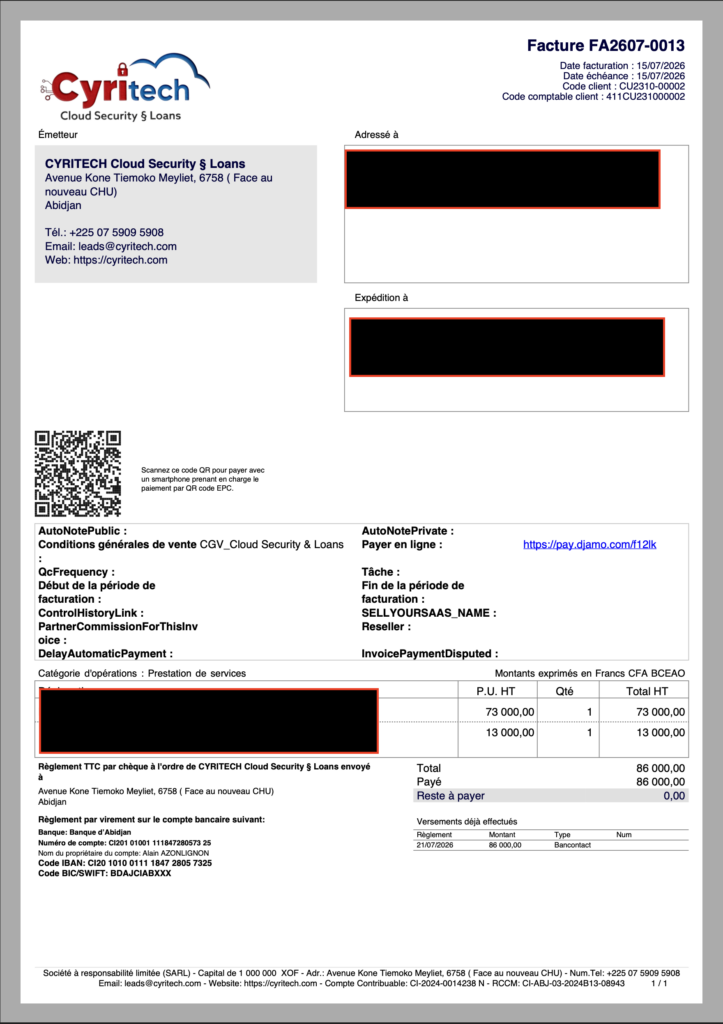
Electronic invoicing and real-time fiscal reporting are no longer a European or Latin American peculiarity. Over the past decade, mandatory e-invoicing and continuous transaction controls have spread across dozens of countries France, Italy, several Gulf states, and a growing number of African tax administrations now require businesses to report transactions electronically, often in real time, directly to the tax authority.
Côte d’Ivoire’s Direction Générale des Impôts (DGI) is part of this shift, with electronic fiscal invoicing requirements (FNE : Facture Normalisée Électronique) now a standard compliance obligation for businesses operating in the country. The direction is clear: tax administrations across the continent are moving toward the same real-time, API-driven model already standard elsewhere.
What’s less discussed is where these mandates actually succeed or fail in practice and it’s rarely the invoicing software itself.
Most businesses assume electronic fiscal compliance is a matter of installing the right software or subscribing to the right service. In reality, invoices don’t originate in a vacuum they originate inside an ERP, alongside inventory, customer records, accounting entries, and payment workflows that already govern how a business runs.
This is where compliance projects typically break down. A fiscal reporting requirement that isn’t wired directly into the ERP creates a parallel, manual process: someone re-entering data, reconciling two systems, and hoping the numbers match at month-end. That approach doesn’t just create friction it recreates the exact reporting gaps that real-time fiscal control was designed to eliminate.
The organizations that adapt smoothly to electronic fiscal mandates are the ones that treat compliance as an ERP-level integration problem, not a bolt-on software purchase. That means:
At CYRITECH, this is the problem FNE PRO was built to solve: a Dolibarr ERP module paired with a multi-country API Gateway that connects directly to DGI’s fiscal compliance infrastructure in Côte d’Ivoire. Rather than treating electronic invoicing as an external service businesses must adapt around, FNE PRO embeds fiscal compliance directly into the ERP workflow businesses already use to manage sales, stock, and accounting.
The API Gateway layer matters particularly for organizations operating across more than one market: it’s built to accommodate multiple fiscal regimes rather than requiring a separate, disconnected tool for each country a business operates in a structural advantage as more tax administrations across the region adopt similar real-time reporting models. A live interactive dashboard gives finance teams visibility into transmission status and compliance state without needing to leave the ERP or reconcile it against a second system.
This is also where CYRITECH’s broader Dolibarr deployment experience in production across Côte d’Ivoire, Sénégal, Bénin, Togo, Cameroun, Congo, and Luxembourg becomes directly relevant: fiscal integration only works reliably when it’s built by teams who understand the ERP layer it has to sit inside, not just the invoicing standard it has to satisfy.
Tax administrations moving to electronic, real-time fiscal control are, in effect, moving toward continuous transaction visibility. For businesses, this changes the cost of a poor integration: errors and delays are no longer caught at year end audit they surface immediately, transaction by transaction.
Businesses that treat electronic fiscal compliance as core ERP infrastructure — rather than a checkbox exercise — end up with cleaner books, faster close cycles, and far less exposure when the next regulatory update arrives. As more African tax administrations follow the same trajectory already well underway in Europe and the Gulf, ERP-level integration will increasingly separate businesses that adapt smoothly from those perpetually catching up to the last mandate.
Learn more about FNE PRO and CYRITECH’s Dolibarr ERP services at cyritech.com or on Alain Azonlignon’s page.